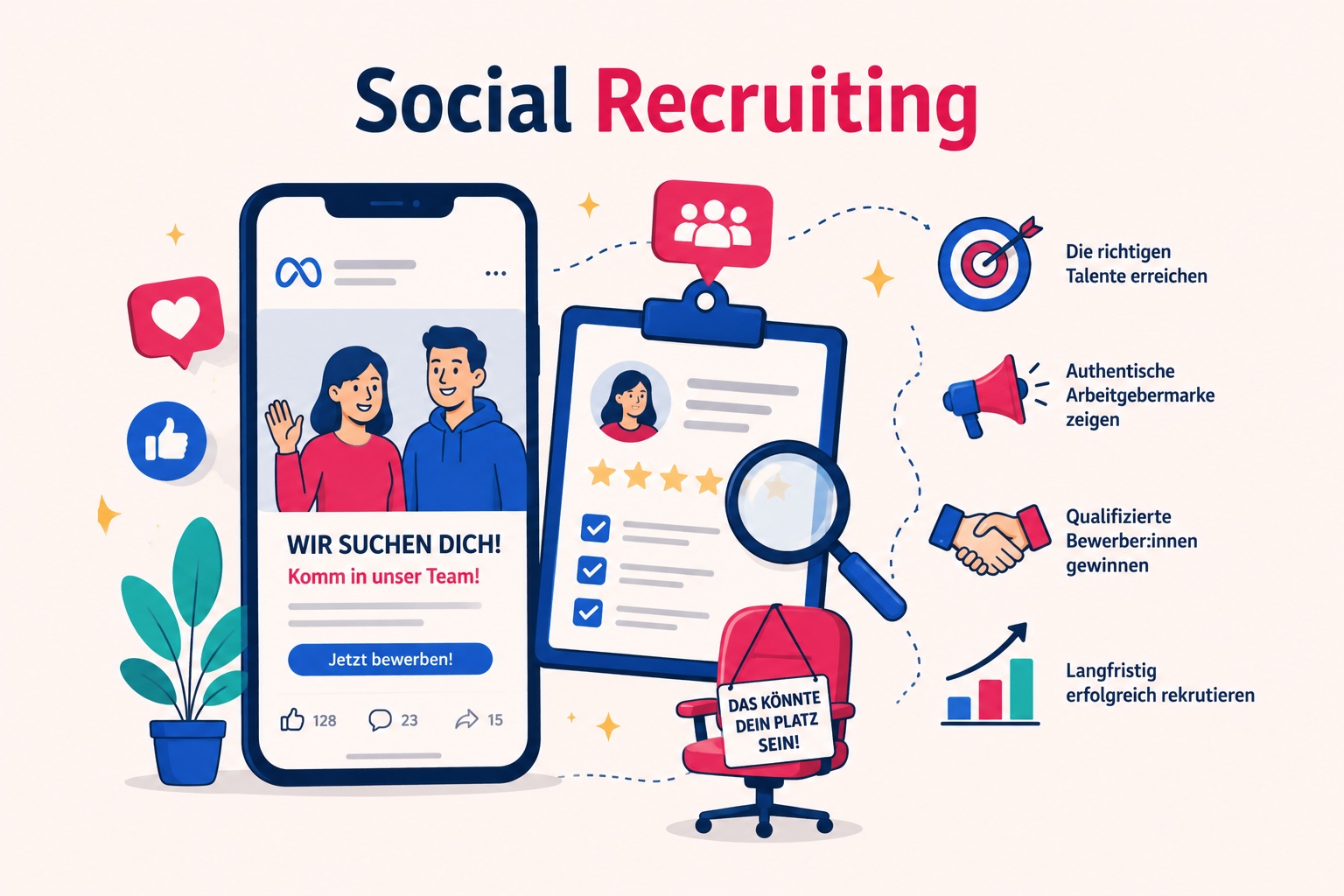
Almost every company strategy mentions the shortage of skilled workers. Yet most recruiting budgets are still locked into traditional job boards — the same companies running the same ads on the same portals, wondering why the right people don't come.
They're overlooking a channel that's massively underestimated in talent acquisition: paid social media ads on Meta (Facebook & Instagram). Done right, social recruiting is one of the most cost-efficient and far-reaching ways to actively reach qualified candidates — including those who aren't actively looking for a new job right now.
What is social recruiting?
Social recruiting means using social media platforms purposefully for talent acquisition — not just organically through company pages, but with paid ads. The key difference from traditional job boards:
On job portals, companies wait for candidates who are actively searching. With social ads, companies actively reach out to candidates — including those who aren't looking, but would be open to the right offer.
Studies show that around 70–80 % of all employees are latently open to changing jobs. They just never open a job board. They scroll through their feed. That's exactly where you can reach them.
Why Meta works so well for recruiting
Facebook and Instagram don't seem like the obvious channel for job advertising at first glance. That's a widespread misconception that costs many companies real talent. Meta offers decisive advantages for recruiting:
- Massive reach: Over 30 million active users in Germany alone — virtually every professional group is represented.
- Precise targeting: Industry, job title, interests, region, commuting distance, behaviours — the targeting toolkit is deep.
- Cost efficiency: CPMs of €5–15 versus several hundred euros for a single job ad on XING or StepStone.
- Speed: A campaign is live within hours — no editorial deadlines, no waiting periods.
- Employer brand made tangible: Video, image, text — on Meta you can show who you really are as an employer instead of just claiming it.
How a recruiting campaign on Meta is built
A recruiting campaign is not a standard product campaign. It needs its own structures, its own creatives and — most often forgotten — its own landing page. Here are the five building blocks that work:
1. Strategy and targeting
Before any ad is placed, the question is: who are we really looking for? Qualification, experience level, region, commuting willingness — this shapes the entire campaign strategy.
For most positions I recommend starting with a broad audience and strong creative. Meta's algorithm is good at finding the right candidates itself — when tracking and creative are solid. For more specific roles, interest targeting (industry interests, professional associations), lookalike audiences (similar to existing employees) or retargeting (career page visitors) come into play.
2. Creatives that actually stop the scroll
The most common mistake in recruiting ads: a corporate-design poster that looks like a 2015 job listing. That doesn't work — neither in results nor in the algorithm.
What works:
- Authentic glimpses — employees talking about their everyday life
- Real photos instead of stock images — the difference is immediately visible
- Concrete benefits that are clear in the first sentence
- Short videos showing the team, atmosphere and company culture
- A clear hook in the first 3 seconds — everything after is a bonus
3. The conversion-optimised landing page — the underestimated bottleneck
Most campaigns lose their effectiveness here: interested candidates click an ad, land on the general careers page or straight into an ATS application form — and drop off. Bounce rates of 70–90 % are not unusual.
A dedicated recruiting landing page for each role changes this fundamentally. It:
- Is specifically tailored to this role and this target audience
- Communicates the value of the position within seconds — not after three scrolls
- Has one single clear call-to-action (short application form instead of a 20-question survey)
- Loads fast on mobile — where the majority of clicks land
- Is properly prepared for conversion tracking
The maths is clear: if the landing page conversion rate improves from 5 % to 15 %, you get three times as many applications with the same ad budget. No other lever has as much impact.
4. Setting up tracking properly
Without clean tracking, the algorithm optimises for the wrong thing — usually cheap clicks instead of qualified applications. For a recruiting campaign you need:
- Meta Pixel correctly installed on the landing page
- Conversion event that fires when an application is submitted — not on every page view
- Conversions API (CAPI) implemented server-side to compensate for data losses from iOS tracking restrictions and ad blockers
- UTM parameters on all ad URLs for clean attribution in GA4 and CRM
5. Campaign setup and management
Recruiting campaigns need their own logic: application volume is lower than in e-commerce, but the value of a single conversion is much higher. Structure accordingly:
- Campaign objective: lead generation or website conversions — no awareness objective
- Not too many ad sets — consolidation helps the algorithm learn faster
- At least 2–3 creative variants running simultaneously
- Daily budget: €20–50 as a starting point; scale once cost per application is stable
- Regular monitoring on CTR, cost per lead and — more important than anything — the actual quality of incoming applications
Common mistakes in social recruiting
- No dedicated landing page: Linking directly to the ATS application page or the generic careers page is the most common and most expensive omission.
- Tracking missing or incomplete: The algorithm doesn't know what an application is — and optimises on nothing useful.
- Budget too small for the learning phase: Meta needs conversion data to learn. With €3 a day, a campaign never exits the learning phase.
- Generic ad copy: "We're looking for an engaged professional" with no concrete benefit. Nobody applies to an ad that doesn't convince them.
- Set-and-forget: Creative fatigue exists in recruiting too. An ad that works in week one won't automatically run until the position is filled.
Conclusion
Social recruiting isn't a trend — it's a structural shift in talent acquisition. Companies that learn today how to reach talent on social media gain a measurable edge over those still waiting for inboxes to fill from job portals.
The key isn't simply running an ad. It lies in the combination of strong creative, a conversion-optimised landing page, clean tracking and a campaign structure that lets the algorithm learn. Those who consistently implement all four building blocks find the right candidates faster — at a fraction of the cost of traditional recruiting channels.
Want to set up your recruiting campaigns professionally?
Want to dig deeper? All services at a glance