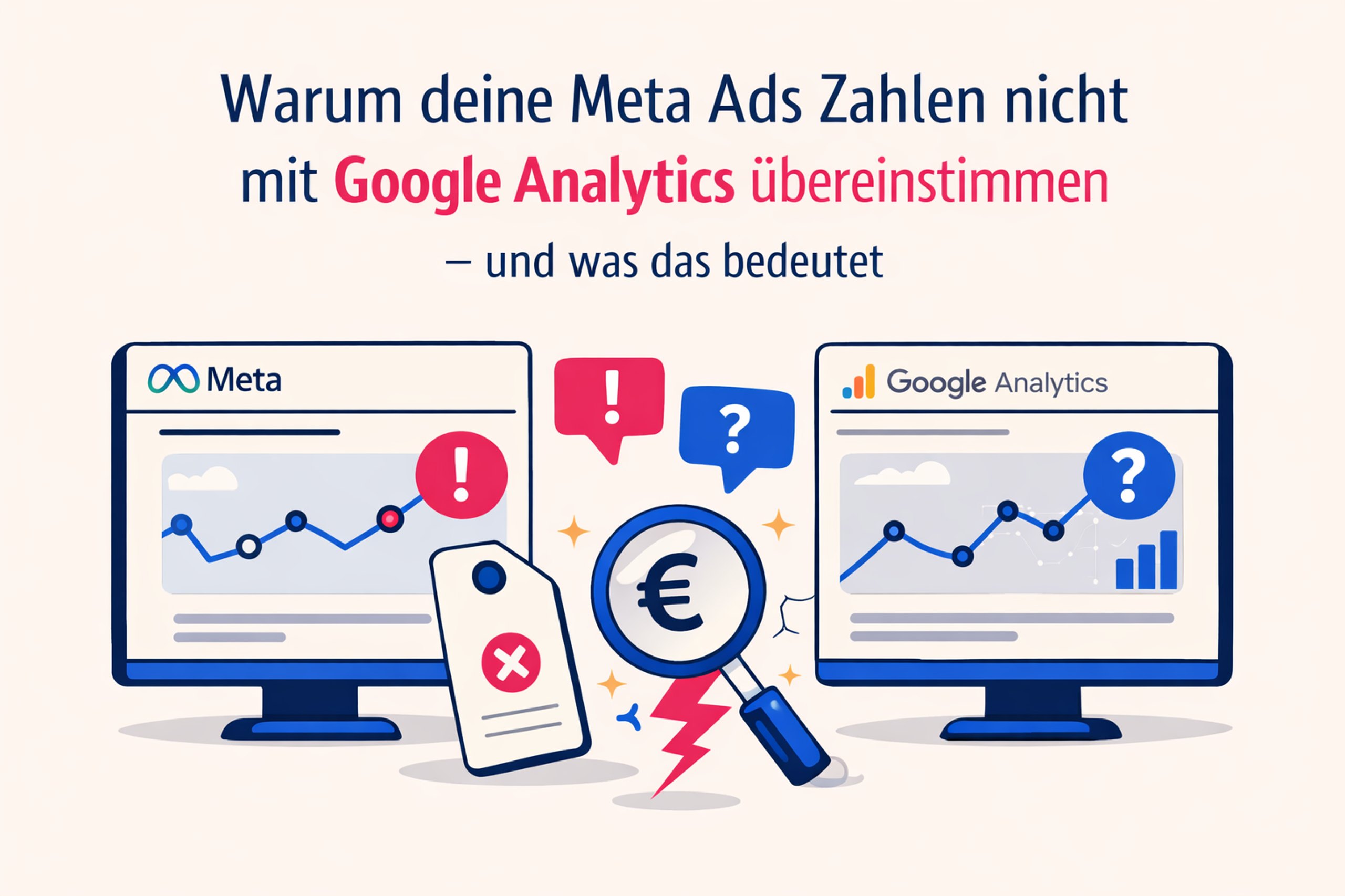
You look at your Meta Ads Manager and see 80 conversions. Then you open Google Analytics — and suddenly there are only 35. This discrepancy isn't an error, it's a system-level difference. Both tools are right — they just measure differently.
The reason is simple: both tools measure differently
Meta counts conversions when users have seen or clicked the ad within the attribution window (e.g. 7 days after click). Cross-device, because users stay logged into their accounts. GA4 uses data-driven attribution across multiple touchpoints, but is based on browser sessions and cookies — and is significantly more limited when devices change.
What else contributes to the differences
Ad blockers and cookie rejection
Browser-based tracking is blocked by ad blockers or prevented by rejected cookies. Meta compensates for this on its platform server-side via the Conversions API — GA4 doesn't have this option by default.
Meta's statistical modelling
Since iOS 14 Meta closes data gaps through modelling — modelled conversions that simply don't exist in GA4.
The attribution window
The time windows differ. Meta can count a purchase 5 days after click on an ad as a conversion — Analytics may attribute the same purchase to the last touchpoint.
Double counting through faulty implementation
When pixel and CAPI run in parallel without deduplication being cleanly configured, conversions in Ads Manager get artificially inflated.
What does this mean for you in practice?
- Don't compare metrics 1:1 — the numbers will never be the same.
- Use Meta for optimisation decisions within the platform.
- Use Analytics to better understand the cross-channel truth.
- Check the tracking setup as soon as the discrepancy is greater than ~50 %.
Conclusion
Variance between platforms is normal — but relevant. Anyone who understands the measurement differences makes better decisions and works with cleaner tracking.
Tracking setup unclear? Happy to take a look.
Du willst tiefer einsteigen? Mehr über Meta Ads Kampagnen